
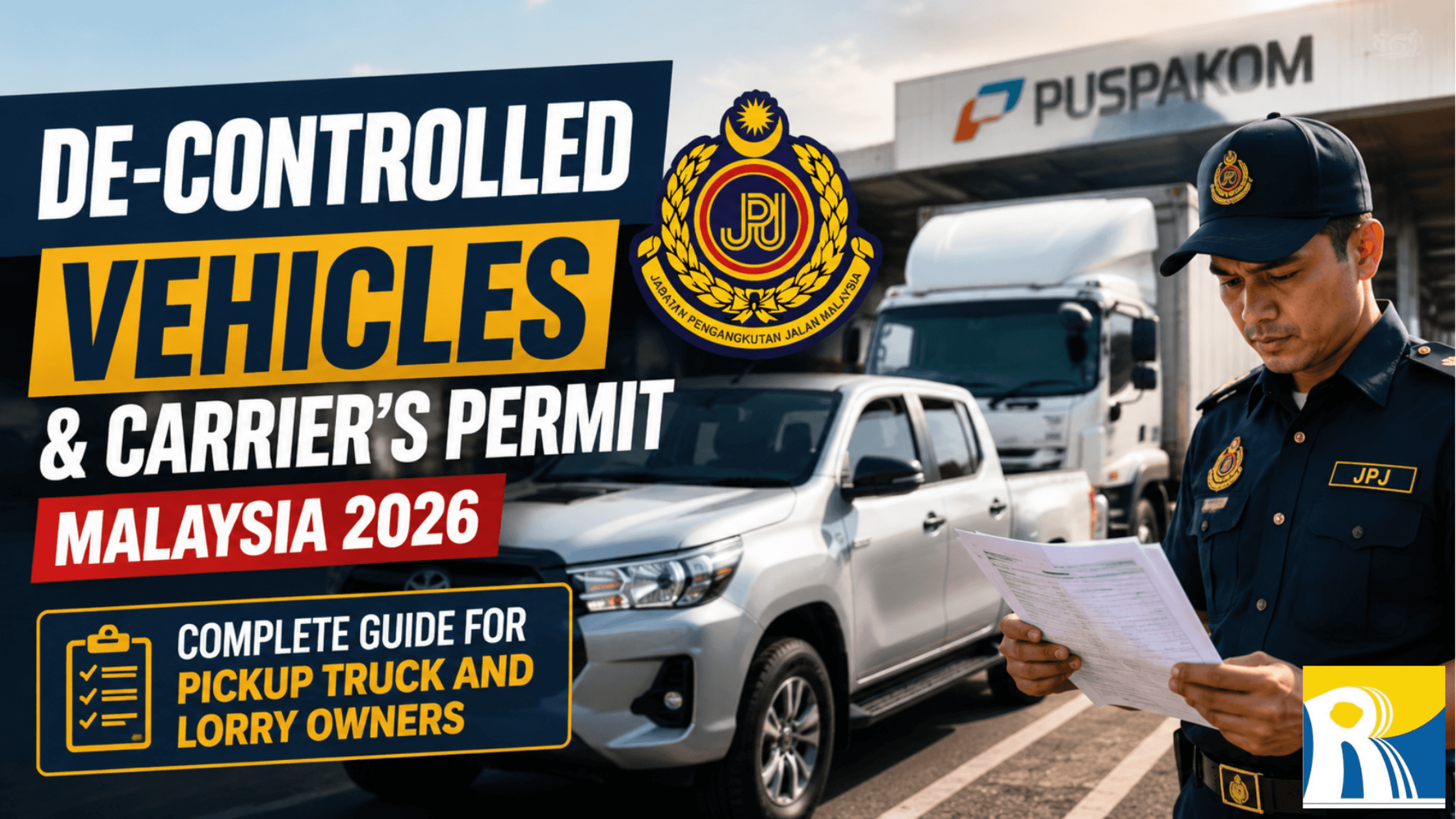
De-Controlled Vehicles and Carrier’s Permit Malaysia 2026: Complete Guide for Pickup Truck and Lorry Owners
Malaysia’s 2026 guideline for decontrolled vehicles changes how pickup truck owners, small business owners, and lorry operators should plan goods transport. The Ministry of Transport announced the new guideline through JPJ on 16 March 2026, and the rule takes effect from 1 April 2026. The guideline covers goods vehicles with BDM not exceeding 7,500 kg, private pickup trucks used for own goods, and vehicles used to carry third-party goods for payment.
The main point is simple. A business owner who uses a qualified pickup truck or lorry to carry their own goods for their own business does not need an APAD operator permit. A company or driver that carries another party’s goods for hire or reward needs a Carrier Permit A from APAD under the Land Public Transport Act 2010.
What De Controlled Vehicle Malaysia Mean in 2026
A de controlled vehicle refers to a goods vehicle with Berat Dengan Muatan, or BDM, not exceeding 7,500 kg, used to carry goods owned by the same owner or company for its own business activity. MOT stated that this category does not need an APAD operator permit when the transport activity involves own goods. This gives small business owners more clarity when they move stock, tools, equipment, or products using their own pickup truck or light lorry.
BDM means the maximum permitted weight of the vehicle together with its load. Owners should check the vehicle grant, manufacturer plate, and approved records before deciding whether the vehicle falls under the 7,500 kg threshold. A pickup truck used for carrying bakery stock, hardware supplies, farm goods, or shop inventory may fall within the guideline when the goods belong to the same owner. The exemption stops when the vehicle carries goods for another party in exchange for payment.
What Changed From 1 April 2026
The new guideline takes effect from 1 April 2026. MOT said the guideline aims to reduce confusion among road users, vehicle owners, and industry players about legal and safe goods transport. It also supports more consistent enforcement by agencies when they check vehicle use on the road.
Before this guideline, many small operators had unclear understanding of pickup truck goods transport and APAD permit requirements. Some owners believed any goods transport needed a permit, while others assumed private vehicles could carry goods for payment without issue. The 2026 guideline separates own goods transport from paid third party transport. This helps owners understand when they fall under simple own use and when they operate a commercial goods transport service.
When You Do Not Need Carrier Permit A APAD
You do not need Carrier Permit A APAD when your de controlled vehicle carries goods that belong to you or your company for your own business. MOT gave this exemption for goods vehicles with BDM not exceeding 7,500 kg, as long as the goods relate to the owner’s business activity. This applies to many small operators who move their own goods between shop, warehouse, worksite, farm, customer location, or branch.
For example, a furniture shop using its own pickup truck to deliver furniture sold by the shop falls under own business goods transport. A contractor using a light lorry to carry its own tools and materials to a project site also fits the same idea. A farm operator using a pickup truck to move its own produce to market follows the own goods concept. The owner still needs to control load safety, vehicle weight, roadworthiness, insurance, and driver licence requirements.
When You Need Carrier Permit A APAD
You need Carrier Permit A APAD when the vehicle carries goods that belong to a third party for hire or reward. MOT stated that this activity counts as commercial goods transport service, and the operator must obtain Permit Pembawa A from APAD under the Land Public Transport Act 2010. This rule applies even when the vehicle falls below the 7,500 kg BDM limit.
For example, a pickup truck owner who accepts paid delivery jobs for other sellers needs to review the APAD permit requirement. A small lorry owner who carries goods from one company to that company’s customer for a fee also moves into commercial goods transport. Courier jobs, paid third party delivery, and rental based goods movement carry higher compliance risk without the right permit. Owners should not treat the de controlled vehicle exemption as approval for paid transport jobs.
Pickup Truck Goods Transport Permit 2026 Rules
Private pickup truck owners receive clearer guidance under the 2026 rule. MOT said private pickup truck owners may carry their own goods if the load stays safe, does not exceed the vehicle load limit, and does not endanger other road users. JPJ also stated that private pickup trucks must follow load limits and must not carry goods that create danger on the road.
This means a pickup truck owner should secure cargo properly before driving. Loose boxes, exposed materials, high stacked goods, and uncovered items raise road safety concerns. The vehicle should not exceed the approved load limit even if the cargo area still has space. A pickup truck may look capable of carrying more, but the legal and safe limit depends on the approved weight, suspension capacity, tyre rating, and vehicle structure.
Class D Licence Rule for De Controlled Vehicles
MOT also stated that Class D driving licence holders receive administrative flexibility to drive de controlled vehicles with Berat Tanpa Muatan, or BTM, up to 4,000 kg. The usual Class D licence limit is 3,500 kg, but the flexibility considers extra weight from cargo bodies or added vehicle structures. JPJ said this adjustment will enter the official guideline for de controlled vehicles.
Owners should not confuse BTM with BDM. BTM refers to unladen vehicle weight, while BDM refers to vehicle weight with load. A vehicle may meet the BDM rule and still require careful licence checking if the unladen weight sits near the limit. Business owners should verify licence suitability before assigning drivers to a pickup truck, box body lorry, bonded truck, tipper body, or other light commercial vehicle.
Common Mistakes That Put Owners at Risk
The first mistake is using a private pickup truck for paid third party delivery without checking APAD permit needs. This often happens when owners accept side delivery jobs, marketplace delivery, courier work, or business to business transport for another company. JPJ stated that enforcement action can apply when a private pickup truck is used for hire or reward activity, as this may involve misuse of motor vehicle licence.
The second mistake is ignoring vehicle weight. A pickup truck or light lorry may qualify as a de controlled vehicle, but it still needs to stay within approved load limits. Overloading creates safety, insurance, and enforcement risk. The third mistake is assuming the exemption removes all compliance duties. Owners still need proper vehicle condition, road tax, insurance, valid driving licence, safe cargo placement, and clear business use records.
How Small Business Owners Should Prepare
Business owners should start by checking the vehicle BDM and BTM. These numbers help determine whether the vehicle sits within the 7,500 kg BDM guideline and whether the driver licence arrangement fits the vehicle. Owners should also write down the exact transport purpose, the goods owner, the delivery route, and whether any customer pays specifically for transport service.
Next, review invoices, delivery orders, and job arrangements. If the goods belong to your business and the delivery supports your own sale or operation, the exemption likely fits the guideline. If another company pays you to carry its goods, that activity points toward Carrier Permit A APAD. This simple review helps owners avoid enforcement problems when JPJ or another agency asks for proof during a roadside check.
How This Rule Affects Lorry Buyers in Malaysia
The 2026 guideline affects buyers who plan to purchase a pickup truck, light lorry, box truck, or rebuilt truck for business use. Buyers should not choose a vehicle based on price and cargo size only. They should match the vehicle BDM, body type, driver licence, ownership use, and APAD permit requirement with the real work they plan to do.
A shop owner who carries own stock needs a different compliance plan from a transport operator who carries third party goods for payment. A contractor who moves its own tools needs a different setup from a company that offers paid delivery service to other businesses. Eco R Truck buyers should explain their actual operation before choosing a vehicle. This helps the team recommend a lorry or pickup setup that fits load, route, budget, and legal use.
FAQ About De Controlled Vehicle Malaysia and Carrier Permit A APAD
What is a de controlled vehicle in Malaysia
A de controlled vehicle is a goods vehicle with BDM not exceeding 7,500 kg used to carry own goods for own business. MOT said this category does not need an APAD operator permit when used for own business goods.
Does a pickup truck need APAD permit to carry goods
A private pickup truck does not need APAD permit when it carries the owner’s own goods safely and within load limits. It needs proper compliance review when it carries third party goods for hire or reward.
When do I need Carrier Permit A APAD
You need Carrier Permit A APAD when you carry goods owned by another party for payment, hire, or reward. MOT treats this as commercial goods transport service under the Land Public Transport Act 2010.
Can a Class D licence holder drive a de controlled vehicle
A Class D licence holder has administrative flexibility to drive a de controlled vehicle with BTM up to 4,000 kg. Owners should verify BTM and BDM before assigning a driver.
Conclusion: De Controlled Vehicle Malaysia Owners Must Check Permit Use Before 1 April 2026
The 2026 de controlled vehicle Malaysia guideline gives small business owners clearer rules for carrying their own goods with pickup trucks and light lorries. The main line is clear, own goods for own business does not need APAD operator permit when the vehicle fits the BDM rule, but third party goods for payment needs Carrier Permit A APAD. Pickup truck owners and lorry buyers should check vehicle weight, driver licence, cargo ownership, and delivery purpose before daily operation.
Eco R Truck helps Malaysian business owners choose new, used, and rebuilt commercial vehicles based on real work needs. Speak with Eco R Truck if you need a pickup truck, light lorry, or commercial vehicle setup for business goods transport. The right vehicle choice helps you manage load, permit needs, financing, and long term operation with fewer compliance problems.
Post Views:
115
You might also like
Diesel Subsidy Malaysia: How Lorry And Truck Operators Track Fuel Cost Changes
Last Updated: September 22, 2026 Diesel subsidy Malaysia policy now runs through a targeted system called
Volvo Electric Truck Malaysia: Cost, Range, And Fleet Fit Explained
Volvo Trucks Malaysia sells the first fully electric heavy duty prime movers in Southeast Asia, with

Isuzu D-Max 2026 Malaysia: Is The New 2.2 Turbodiesel Worth It For Business Buyers
A low purchase price does not automatically make a pickup the cheaper business asset. The Isuzu D-Max

Malaysia’s Most Trusted Commercial Vehicle Brands 2026: Top 7 Truck Brands Buyers Choose
Isuzu leads Malaysia’s most trusted commercial vehicle brands in 2026, with 6,880 truck registrations

Eco‑R Truck Authorized Distributor of XCMG Malaysia Truck-Mounted Cranes, Knuckle Boom Cranes, Loader Cranes, Excavators and Construction Machinery
Sendok Group is the sole distributor of selected XCMG truck-mounted cranes in Malaysia. The crane operation
EV Truck Charging Station Malaysia 2026: Where Trucks Charge
Key Takeaway: Malaysia has thousands of public EV chargers, but few sites support electric trucks. Build